 WomenBet
Tracking Your Bets
 Available in US

Ask any consistently profitable sports bettor what separates them from recreational gamblers, and tracking will inevitably come up. Not gut feelings, not secret systems, not insider information—disciplined record-keeping of every single wager. Without tracking, you're betting blind, unable to distinguish skill from luck, profitable strategies from losing ones, or actual results from selective memory.
Human memory is notoriously unreliable when it comes to gambling outcomes. We remember the big wins vividly while the small losses blur together and fade. We recall the clever bets that paid off while forgetting the equally confident wagers that didn't. This creates a distorted picture of our betting performance that almost always skews more positive than reality.
A tracking spreadsheet cuts through this self-deception. It provides objective data about what actually happened, revealing patterns and problems that memory conceals. Whether you're betting for entertainment or seriously pursuing profit, systematic tracking transforms your betting from guesswork into informed decision-making.
What to Track: Essential Fields
Every bet tracking system needs certain core information to be useful. Here are the fields you should capture for each wager.
Date provides context for analyzing your betting over time. You'll want to see how your performance changes week over week, month over month, and season over season. Date tracking also helps identify whether you perform differently during certain periods—maybe you bet worse during busy work weeks or better during particular sports seasons.
Sport and league allow you to analyze performance by category. You might discover you're profitable betting on WNBA games but losing money on NFL props. Without tracking by sport and league, this insight remains hidden. Focus your betting where the data shows you perform best.
Teams or event identifies what you actually bet on. While this might seem obvious, having the specific matchup recorded helps you review your thinking process and identify whether you consistently misjudge certain teams or situations.
Bet type distinguishes between moneylines, spreads, totals, props, and parlays. Different bet types have different characteristics; tracking them separately reveals where your analytical edge actually exists—and where it doesn't.
Odds at the time you placed your bet are essential for calculating returns and evaluating whether you're consistently getting good prices. Decimal odds are easiest for spreadsheet calculations, though you can use American odds and convert them.
Closing line represents the final odds before the event started, after all betting action has influenced the price. Comparing your bet odds to closing lines shows whether you're consistently beating the market—a key indicator of long-term profitability regardless of short-term results.
Stake is how much you wagered, whether in dollars or units. Consistent unit sizing makes comparison across bets easier; recording actual dollar amounts helps track total financial impact.
Sportsbook identifies where you placed the bet. This reveals which books give you the best odds for different bet types and helps you manage funds across multiple accounts.
Result should be straightforward: Won, Lost, Push, or Pending. Avoid creating complicated result categories; simplicity makes analysis easier.
Profit/Loss calculates the actual money gained or lost on each bet. For wins, this is your payout minus your stake; for losses, it's your stake as a negative number. This column forms the foundation for all performance analysis.
Notes capture your reasoning for the bet, any relevant context, and post-event reflections. These qualitative notes often prove more valuable than raw numbers when reviewing what's working and what isn't.
Setting Up Your Spreadsheet
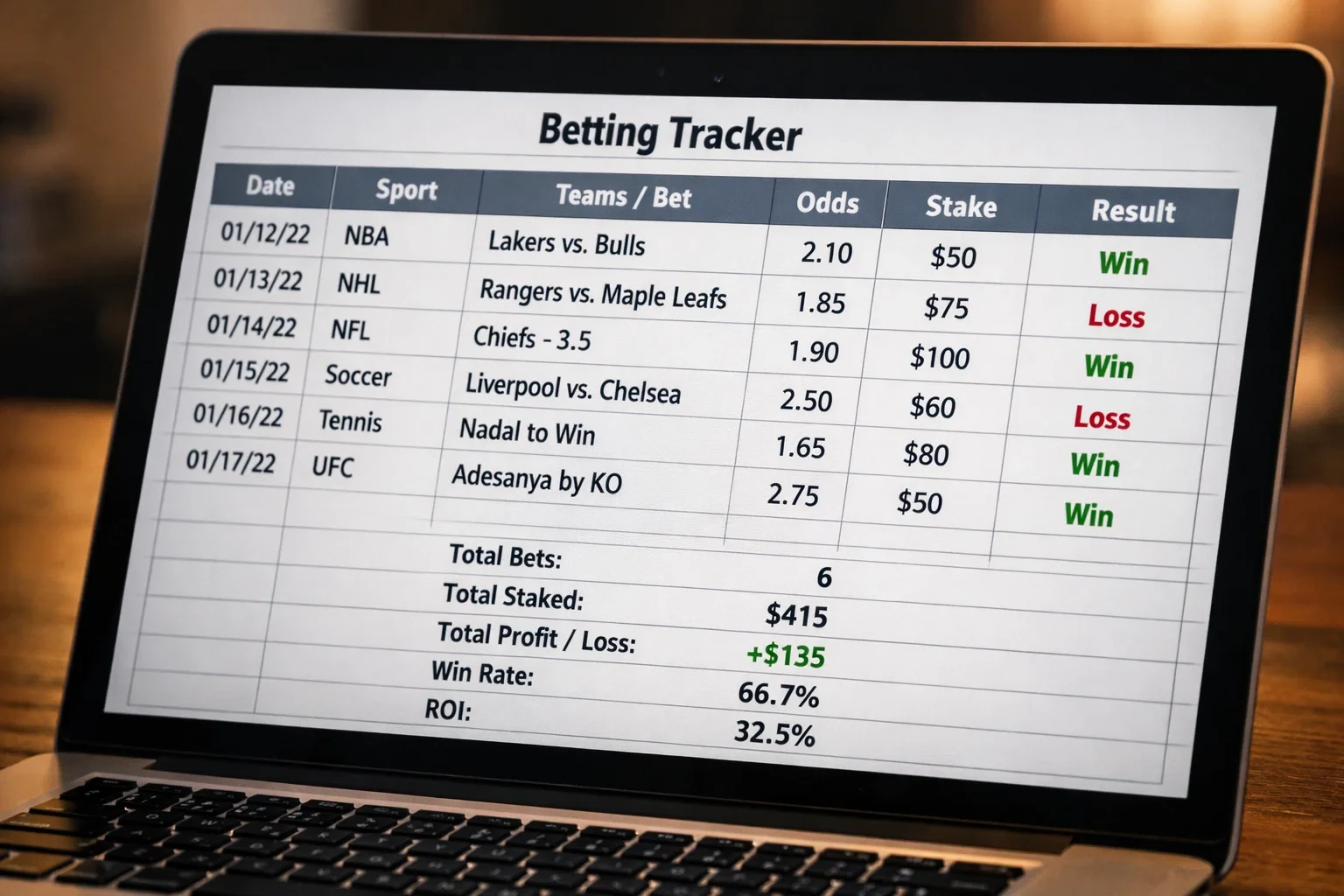
Google Sheets or Microsoft Excel both work well for bet tracking. Google Sheets offers the advantage of cloud access from any device, automatic saving, and easy sharing if you want feedback from others. Excel provides more powerful analysis features for those who want to get sophisticated.
Create column headers for each field described above. Your first row should contain these labels; all subsequent rows will be individual bets. Keep everything in one master sheet rather than creating separate sheets for different sports—you can filter and sort later.
Add a summary section at the top or on a separate tab that calculates your key metrics automatically. Use formulas so these update whenever you add new bets.
Total profit/loss is simply the sum of your profit/loss column. This is your bottom line—the ultimate measure of results.
Total wagered sums all your stakes. This provides context for your profit/loss figure and is essential for calculating ROI.
Return on Investment (ROI) equals total profit divided by total wagered, expressed as a percentage. This measures your efficiency—how much you're earning relative to the amount you're risking. A 5% ROI means you're earning $5 for every $100 wagered, which is actually excellent performance over meaningful sample sizes.
Win rate counts wins divided by total resolved bets (excluding pushes and pending bets). While less important than ROI for profitability analysis, win rate provides useful context and feels more intuitive for most people.
Record displays your wins, losses, and pushes as a simple tally. This gives you an at-a-glance summary of your betting history.
Advanced Tracking: Closing Line Value
Serious bettors track one metric above all others: closing line value (CLV). This measures whether the odds you bet at were better than the final closing odds—essentially, whether you beat the market.
Here's why CLV matters more than win rate or even ROI in shorter timeframes: luck heavily influences individual bet outcomes, but consistently beating closing lines indicates genuine skill that will translate to profit over time. If you consistently bet teams at +150 that close at +130, you're identifying value the market eventually recognizes—even if variance means you don't win as often as the closing line suggests you should.
To track CLV, record both your bet odds and the closing odds. Calculate the percentage difference between them. Positive CLV (you got better odds than closing) indicates potential skill; negative CLV (you got worse odds than closing) suggests you're either betting too late, betting on inflated lines, or lacking genuine edge.
Many successful bettors focus more on their CLV trends than their actual results, trusting that beating the market will eventually translate to profit even if short-term results fluctuate due to variance.
Analyzing Your Data
Raw data becomes valuable through analysis. Here are key ways to examine your betting history.
Filter by sport and league to see where you perform best. Maybe you're profitable on women's basketball but losing on tennis. This insight should directly influence your betting allocation—bet more where you have demonstrated edge, less where you don't.
Filter by bet type to understand your strengths. Perhaps your spread bets are profitable but your prop bets consistently lose. Or your moneylines work but parlays destroy your bankroll. Let the data guide which bet types deserve your action.
Filter by sportsbook to identify which books consistently offer you the best prices. You might find that Book A gives better basketball lines while Book B is superior for soccer.
Look at performance over time to spot trends. Are you improving as you learn, or has a once-profitable approach stopped working? Did something change in your betting after a particular date that affected results?
Examine your notes for patterns in your reasoning. What characterizes your winning bets versus your losing ones? Are there common factors in your successful wagers that you can emphasize going forward?
Calculate results at different odds ranges to see if you perform differently on favorites versus underdogs, or on heavy favorites versus slight favorites. Some bettors have edge in specific odds ranges that disappears at others.
Learn successfully to compare betting odds.
Monthly and Quarterly Reviews

Data collection only helps if you actually review it. Schedule regular times to analyze your betting performance—monthly at minimum, with deeper quarterly reviews.
During these reviews, calculate your key metrics for the period. Compare against previous periods to spot trends. Identify your most and least profitable areas. Look for any patterns in your losing bets that might indicate systematic errors.
Ask yourself hard questions: Is my betting actually profitable, or am I just remembering the wins? Which bet types should I emphasize versus avoid? Am I getting good closing line value? What's my actual ROI, not the fuzzy number I imagine?
These reviews often reveal uncomfortable truths. You might discover that your "profitable" NFL betting is actually break-even while your "hobby" WNBA bets are generating real returns. You might find that the bet types you enjoy most are the ones where you lose money. Let the data override your preferences and intuitions.
Common Tracking Mistakes
Several errors undermine the value of bet tracking.
Incomplete recording destroys your data's reliability. If you only log some bets—perhaps the big ones or the winners—your analysis becomes meaningless. Track every single bet, no matter how small or embarrassing.
Waiting to record leads to forgotten details and eventual abandonment of tracking. Log bets immediately after placing them, before you have the chance to forget or get lazy.
Too many categories creates analysis paralysis. Start simple with the essential fields; you can always add more later. A simpler system you actually use beats a complex one you abandon.
Not reviewing the data makes tracking pointless. The spreadsheet isn't just a record; it's a tool for improvement. If you're not analyzing your data regularly, you're just documenting failure rather than learning from it.
Ignoring uncomfortable findings defeats the purpose. If your data shows you're losing money, accept that reality and change your approach. Tracking only helps if you're willing to act on what it reveals.
Tracking Apps as Alternatives
While spreadsheets offer flexibility and customization, several apps now automate bet tracking. Tools like Action Network, BettorEdge, Pikkit, and others can sync with sportsbook accounts to import bets automatically, eliminating manual entry.
These apps typically provide pre-built dashboards, visualizations, and analytics that would require spreadsheet expertise to replicate. Some offer social features that let you compare performance against other users or share your results.
The tradeoff is less customization and potential subscription costs. Many bettors start with free spreadsheet templates and graduate to apps as their volume increases and manual entry becomes burdensome.
Whether you choose a spreadsheet or an app, the principle remains identical: systematic, complete tracking of every wager creates the foundation for understanding and improving your betting performance.
Getting Started Today
Don't let perfect be the enemy of good. You don't need a sophisticated multi-tab spreadsheet with advanced formulas to start tracking. A simple list with date, bet, odds, stake, and result provides enormous value compared to no tracking at all.
Create a basic spreadsheet today—right now, before your next bet. Start logging every wager. After a month, review what you've collected. Add complexity gradually as you understand what additional data would be useful.
The bettors who track consistently develop advantages that non-trackers cannot match. They understand their actual performance rather than their imagined performance. They identify weaknesses before those weaknesses drain their bankroll. They make evidence-based decisions about where to focus their betting.
Start tracking today. Your future betting self will thank you.
Make correctly calculated choices at women bet.
