 WomenBet
Sports Betting for Women Beginners: The Complete Step-by-Step Guide
 Available in US

Starting sports betting feels overwhelming because the entire industry spent decades building products for men who grew up with fantasy sports and already understood the terminology. Walk into any discussion of sports betting and you'll encounter jargon, assumed knowledge, and cultural references that presume a lifetime of male sports fandom. None of this actually matters for learning to bet successfully, but it creates unnecessary barriers that discourage many women from even trying.
The truth is that sports betting is simpler than it looks once you strip away the intimidating presentation. You're predicting outcomes and wagering money on those predictions. The complexity comes from options and variations, not from the core concept. A complete beginner can understand everything necessary to place intelligent bets in a few hours of focused learning. The industry benefits from making betting seem more complicated than it is, but you don't have to accept that framing.
Women actually have several advantages as betting beginners. Research shows that female bettors achieve better returns than men on average, develop problem gambling at lower rates, and demonstrate superior emotional control and bankroll management. These advantages come from psychological and behavioral patterns that women bring naturally to betting. You don't need to become an expert immediately or adopt aggressive strategies that feel uncomfortable. Your natural approach probably works better than what conventional betting wisdom prescribes.
This guide exists because most betting advice assumes male psychology, male motivations, and male behavioral patterns. That advice might actively harm female bettors by pushing approaches that contradict your natural strengths. Starting with strategies designed around how women actually bet—rather than how men think everyone should bet—provides better foundation for long-term success.
The steps that follow represent a realistic path from complete beginner to confident bettor. Nothing here requires extensive sports knowledge, mathematical sophistication, or risk tolerance that makes you uncomfortable. The goal is getting you to the point where you can make informed betting decisions independently, understand what you're doing, and maintain healthy patterns that keep betting fun rather than stressful. Everything beyond that is optional refinement you can pursue if and when it interests you.
Understanding Sports Betting Basics
Sports betting means predicting outcomes of sporting events and wagering money on those predictions. If your prediction is correct, you win money based on odds that were set when you placed the bet. If your prediction is wrong, you lose the amount you wagered. Everything else is elaboration on this simple framework.
Odds are the fundamental concept you must understand. They serve two purposes: indicating how likely bookmakers think each outcome is, and determining how much you win relative to what you risk. American odds use positive and negative numbers that seem confusing initially but make sense once you understand the pattern.
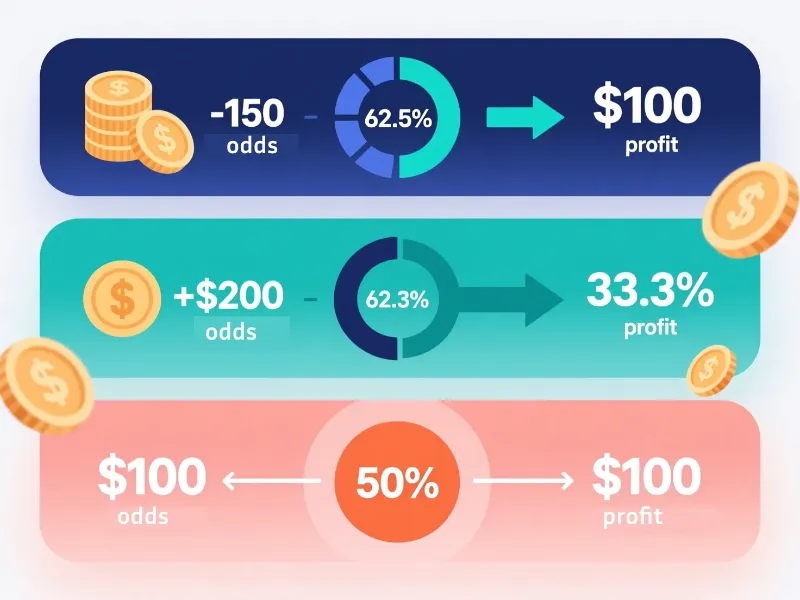
Negative odds show how much you need to wager to win one hundred dollars. A team at -150 means you must bet one hundred fifty dollars to win one hundred dollars in profit. Your total return would be two hundred fifty dollars—your original one hundred fifty stake plus one hundred dollars profit. Favorites always have negative odds because they're expected to win, so you must risk more money to win less.
Positive odds show how much profit you win if you wager one hundred dollars. A team at +200 means betting one hundred dollars wins you two hundred dollars profit. Your total return would be three hundred dollars—your original one hundred stake plus two hundred profit. Underdogs have positive odds because they're expected to lose, so you risk less money for potentially larger returns.
Understanding this odds system lets you calculate potential returns before betting. A fifty dollar bet on a -150 favorite returns approximately thirty-three dollars profit if it wins. A fifty dollar bet on a +200 underdog returns one hundred dollars profit if it wins. The math becomes automatic with practice, but starting out you can use odds calculators available free online.
Implied probability converts odds into the percentage chance bookmakers are assigning to each outcome. This calculation helps evaluate whether a bet offers value. For negative odds, divide the odds by odds plus one hundred. A team at -150 has implied probability of 150 divided by 250, which equals sixty percent. For positive odds, divide one hundred by odds plus one hundred. A team at +200 has implied probability of 100 divided by 300, approximately thirty-three percent.
These implied probabilities always sum to more than one hundred percent across all possible outcomes of an event. This excess—called the vig or juice—represents the bookmaker's built-in profit margin. A typical two-outcome market might have implied probabilities summing to one hundred five percent, meaning the bookmaker has a five percent edge regardless of outcome. Understanding the vig explains why betting profitably is difficult—you're competing against probability while giving the house a mathematical advantage.
The point spread equalizes betting on mismatched teams. Instead of simply picking the winner, you're betting on whether the favorite wins by more than the spread or whether the underdog loses by less than the spread. A team favored by seven points must win by eight or more for a bet on them to win. The underdog can lose by six or fewer and bets on them still win. If the favorite wins by exactly seven, it's a push—all bets are refunded.
The moneyline is simpler—just pick which team wins outright. No point spreads, no complexity. Favorites have negative odds, underdogs have positive odds. This straightforward format is perfect for beginners because it requires only predicting the winner.
Totals, also called over/under, involve betting on the combined score of both teams. The bookmaker sets a number, and you bet whether the actual total will be over or under that number. This bet type doesn't require picking a winner, just estimating scoring levels.
These three bet types—spreads, moneylines, and totals—form the foundation of sports betting. Everything else is variation or combination. Master these basics before exploring more complex options. Complexity doesn't improve results for beginners and usually just increases confusion and mistakes.
Sports betting means predicting outcomes of sporting events and wagering money on those predictions. If your prediction is correct, you win money based on odds set when you placed the bet. If wrong, you lose the amount wagered. Everything else is elaboration on this simple framework.
Setting Up Your First Betting Account
Choosing a sportsbook is your first practical decision. Dozens of legal options exist in most states, and they're not equivalent. Quality varies dramatically across user experience, odds quality, customer service, and financial reliability. Making the right choice prevents future headaches.

Start by verifying legal status in your location. Sports betting is legal in many US states but not everywhere. Check your state's gaming commission website for current status. Using illegal offshore books creates unnecessary risk—legal problems, no consumer protection, no recourse if the site refuses payouts. The slight inconvenience of legal restrictions beats the massive downside of illegal betting.
Major established sportsbooks like FanDuel, DraftKings, BetMGM, and Caesars dominate most legal markets. These companies are publicly traded or backed by major casino operators. They have reputations to protect, regulatory oversight to satisfy, and resources to maintain quality operations. Smaller books might offer better odds on specific bets, but for beginners, reliability and user experience matter more than marginal odds improvements.
Download apps from multiple sportsbooks and explore interfaces before funding accounts. User experience varies significantly. Some apps are intuitive and clean, others are cluttered and confusing. Find one that makes sense to you immediately. You'll use this interface frequently—if it feels awkward during exploration, it will feel worse when you're trying to place time-sensitive bets.
Compare welcome bonuses, but don't let them dominate your decision. Most sportsbooks offer deposit matches—bet one hundred, get one hundred in bonus bets. These sound great but come with terms. Bonus money requires wagering multiple times before withdrawal. Requirements vary from reasonable to nearly impossible. Read the complete terms before accepting any bonus. Sometimes taking a smaller bonus with better terms beats a larger bonus with restrictive requirements.
Look for responsible gambling tools during your evaluation. Deposit limits, loss limits, time limits, and self-exclusion options should be easily accessible and simple to implement. Sportsbooks that bury these features or make them difficult to use are showing you their priorities. Companies that prominently feature responsible gambling tools generally operate more ethically.
Funding your account typically works through bank transfer, debit card, or payment apps like PayPal or Venmo. Bank transfers are slowest but most reliable. Debit cards work instantly but some banks block gambling transactions. Payment apps fall somewhere between. Test a small deposit initially to confirm your funding method works before committing significant money.
Identity verification is required by law and cannot be avoided. You'll submit driver's license photos, social security number, and possibly additional documentation. This feels invasive but protects against money laundering and underage gambling. Legitimate sportsbooks handle this information securely. Offshore books requesting this information are riskier—they're not subject to the same regulatory oversight and data protection requirements.
Account setup takes fifteen to thirty minutes when you have all required information ready. Have your ID, banking information, and proof of address available. The verification process can take hours to days depending on the sportsbook. Don't wait until you want to bet urgently to set up accounts. Get verified in advance so you're ready when opportunities arise.
Developing Your Bankroll Strategy
Bankroll management is the most important skill in sports betting. It matters more than analytical ability, sports knowledge, or betting strategy. Poor bankroll management destroys profitable bettors. Excellent bankroll management keeps mediocre bettors in action indefinitely. Master this before focusing on anything else.

Your bankroll is money designated specifically for betting. This is not money you need for bills, savings, or regular expenses. It's entertainment money that you can afford to lose completely. If losing this money would cause financial stress or require lifestyle changes, you're starting with too much. Reduce the amount until losing it would merely be disappointing rather than damaging.
Most beginners should start with three hundred to one thousand dollars. This provides enough cushion to survive inevitable losing streaks while remaining a manageable loss if betting doesn't work out. Starting smaller than three hundred limits your flexibility and makes variance overwhelming. Starting larger than one thousand risks too much before you've learned fundamental lessons.
The unit system standardizes bet sizing regardless of bankroll. One unit equals one percent of your bankroll. A five hundred dollar bankroll means one unit is five dollars. A two thousand dollar bankroll means one unit is twenty dollars. This system scales automatically—as your bankroll grows or shrinks, your unit size adjusts proportionally.
Standard bet sizing for beginners is one to two units per bet. This conservative approach protects your bankroll during learning. You can place fifty to one hundred bets before depleting your roll even if you're completely unsuccessful. This runway gives you time to learn from mistakes without going broke immediately.
Never bet more than five percent of your bankroll on any single event, regardless of confidence. The temptation to bet larger on "sure things" is overwhelming, especially when you've researched thoroughly and feel certain. But sure things lose regularly in sports. Injuries happen. Fluky bounces determine outcomes. Officials make questionable calls. No bet is safe enough to risk significant portions of your bankroll.
Separate your bankroll from regular finances completely. Many bettors use dedicated accounts or payment apps exclusively for betting. This separation provides clear visibility into betting performance and prevents accidentally dipping into bill money after losses. If your betting account reaches zero, you stop betting until you deliberately choose to deposit more entertainment money.
Recalculate your unit size regularly—weekly or after significant wins or losses. As your bankroll grows, your unit size increases, allowing larger bets. As your bankroll shrinks, your unit size decreases, protecting remaining funds. This dynamic adjustment is the key to long-term survival.
Set loss limits in addition to bankroll limits. Daily, weekly, and monthly loss limits prevent catastrophic downswings from devastating your bankroll. A reasonable structure might be: stop betting for the day after losing ten units, for the week after losing twenty units, or for the month after losing fifty units. These limits force breaks during bad runs when emotional decision-making is most dangerous.
Track every bet in a spreadsheet or betting app. Record date, event, bet type, odds, stake, and result. This record shows patterns in your betting that you won't notice otherwise. Maybe you consistently lose on underdogs. Maybe afternoon games treat you better than evening games. Data reveals truths that memory obscures.
Creating Your Research Process
Research is where betting skill develops. Anyone can click buttons and place bets. Consistently finding value in betting markets requires systematic information gathering and analysis. The specific research process matters less than having a consistent process you actually follow.
Start by choosing sports you already understand or genuinely enjoy watching. Betting on sports you don't care about makes research tedious and success unsatisfying. If you love basketball, focus there. If soccer interests you, specialize in that. Generic advice suggests betting the most popular sports, but your engagement and existing knowledge matter more than market liquidity.
Injury reports are the most time-sensitive information affecting betting value. Key player absences dramatically shift odds, especially in basketball and football where individual players have massive impact. Check official injury reports from team websites or league sources, not rumors on social media. Understand the difference between probable, questionable, doubtful, and out designations. Each represents different likelihood of playing.
Recent form matters more than season statistics. A team might have excellent overall record but be playing poorly recently, or vice versa. Look at last five to ten games rather than full season performance. Check win-loss records but also watch for trends in scoring, defense, and performance against quality opponents.
Head-to-head history provides context but shouldn't dominate analysis. Some teams consistently match up well against specific opponents regardless of current form. This information is worth noting but overweighting historical matchups causes mistakes. Teams change players, coaches, and strategies. Last year's results don't guarantee anything about today's game.
Weather significantly impacts outdoor sports. Wind affects passing games in football and fly balls in baseball. Rain slows play and reduces scoring. Extreme temperatures influence player performance and game pace. Check weather forecasts for game location and understand how conditions might affect the specific sport you're betting.
Home court or home field advantage is real but varies by sport and team. Basketball home advantage is roughly three points. Football home advantage is approximately two to three points. Some teams play dramatically better at home, others show little difference. Research individual team home/away splits rather than assuming standard advantage.
Motivation factors matter in specific situations. Teams fighting for playoff spots play harder than eliminated teams. Regular season games against rivals carry extra intensity. Trap game scenarios—where favorites overlook supposedly inferior opponents—create betting value. Understanding situational motivation helps identify games where the obvious pick might be wrong.
Line shopping means comparing odds across multiple sportsbooks before betting. The same bet might be -110 at one book and -105 at another. Over time, consistently getting better odds compounds significantly. Maintain accounts at three to five sportsbooks to enable effective line shopping. The extra accounts require more management but improve profitability measurably.
Betting against yourself—finding reasons your initial instinct might be wrong—is advanced research technique. After identifying a bet you like, deliberately search for counterarguments. What would make the opposite outcome likely? What information might you be overlooking? This devil's advocate approach prevents confirmation bias.
Understanding Bet Types and When to Use Them
Different bet types serve different purposes. The same game can be bet in multiple ways, and choosing the right bet type matters as much as picking the right side. Understanding when each bet type is optimal improves results significantly.
Moneyline bets are simplest and best for beginners. Pick the winner, ignore point spreads. This clarity eliminates spread-related bad beats where your team wins but doesn't cover. Moneylines work best when you have strong conviction about outcome but uncertainty about margin. They're also preferable in sports like baseball or hockey where low-scoring games make spreads less meaningful.
Point spread bets offer better value on heavy favorites. Taking a favorite at -250 moneyline means risking two hundred fifty dollars to win one hundred. Taking the same favorite at -7 at -110 means risking one hundred ten to win one hundred. If you believe the favorite will win comfortably, the spread offers better risk-reward. But you accept margin risk—the favorite can win but fail to cover.
Underdog spreads are the highest expected value bet type for recreational bettors. Research shows that underdogs cover spreads at higher rates than odds suggest. This edge exists because the betting public overvalues favorites, creating line value on underdogs. Starting bettors should emphasize underdog spreads until developing more sophisticated approaches.
Totals provide action when you have no strong opinion on winner. Maybe two strong offenses are facing weak defenses—bet over regardless of who wins. Or two defensive teams are playing in bad weather—bet under. Totals diversify your betting beyond picking winners and create opportunities in games where you can't handicap the outcome.
First half or first quarter bets let you capitalize on specific tendencies. Some teams start slow but finish strong, or vice versa. Some coaches script opening drives carefully, creating first quarter value. These bets resolve quickly, limiting exposure to late-game variance. They're also useful for live betting—watching first quarter helps inform second quarter bets.
Team totals isolate one team's performance rather than combined scoring. This bet type works when you're confident about one team's offense or defense but uncertain about the opponent. A strong offense against weak defense might hit their team total regardless of opponent's performance.
Alternate lines let you adjust point spreads or totals in exchange for different odds. Taking a favorite at -3 instead of -7 improves your chances but reduces payout. This option is useful when you like a team but worry about covering the full spread. Or when you want to bet conservatively on outcome you expect but aren't certain about.
Parlays combine multiple bets into one ticket. All selections must win for the parlay to cash. Payouts are higher but probability of winning is much lower. Parlays are negative expected value bets that only make sense for entertainment purposes. They're not investment vehicles. If you bet parlays, treat them as lottery tickets—fun low-stake bets, not serious money.
Teasers let you adjust multiple point spreads in your favor in exchange for reduced payout. Most commonly, six-point teasers in football move two or three spreads by six points each. These can be profitable if used strategically around key numbers. But like parlays, all legs must win, creating higher risk than straight bets.
Live betting or in-game betting lets you bet after games start. Odds update continuously based on game flow. This format offers advantages and disadvantages. Advantages: you see how teams are actually playing before committing money. Disadvantages: odds adjust quickly and emotions run higher betting during games. Live betting requires different skills than pregame betting and isn't necessarily easier despite the additional information.
The best bet type depends on your specific read of the game. Use moneylines when you're confident in outcome but not margin. Use spreads when the margin matters to your analysis. Use totals when scoring patterns are clearer than winner. Don't force yourself into specific bet types based on convention—match the bet to your actual opinion about the game.
Sports-Specific Betting Considerations
Each sport has unique characteristics that affect betting approach. Generic betting principles apply everywhere, but specific sports require adjusted thinking. Understanding these distinctions improves decision-making.
Football is the most popular betting sport in America. The game's weekly schedule creates massive public interest in each game. Point spreads are most refined in football because of betting volume. Key numbers matter—more games land on three and seven than any other margins. Teasing through these numbers creates value. Weather impacts outdoor games significantly. Road underdogs cover at higher rates than home favorites historically.
Basketball is second in betting popularity. High possession counts reduce variance compared to football. The better team wins more consistently, making favorites safer but less profitable. Home court is worth approximately three points but varies by team. Betting against public tends to work—casual bettors overvalue popular teams. Back-to-back games, road trip fatigue, and injury reports matter more in basketball's compressed schedule. Late-season rest games create value when teams sit stars.
Baseball is hardest to bet profitably. The best teams lose sixty games. The worst teams win sixty games. Variance dominates. Starting pitchers are most important variable—their performance determines outcomes more than team quality. Baseball favors underdogs more than any major sport. Betting favorites consistently loses money due to juice. Weather affects totals dramatically—wind matters more than temperature. Umpire tendencies influence totals—some consistently call large strike zones reducing runs.
Hockey betting resembles baseball—high variance, low scoring, starting goalies are critical. Shootouts add randomness. Home ice is worth less than in other sports. Betting favorites is expensive due to low-scoring nature. Totals are typically five or six goals total—one goalscoring sequence significantly impacts outcomes. Back-to-back games matter more in hockey than other sports because fatigue is so physical.
Soccer is growing in American betting markets. Low scoring makes outcomes highly variable. Draw is third outcome that must be considered. Many bets push on draws, which changes math. Team news—injuries and lineup changes—comes very late compared to American sports, sometimes hours before matches. European leagues have massive quality differences between top and bottom teams, creating large favorites that rarely offer value. Totals are typically around 2.5 goals. Weather matters less than in American sports.
Tennis is individual sport betting, which changes dynamics entirely. Player form, surface preference, and head-to-head history matter more. Injuries are harder to assess—players compete hurt more than in team sports. Matches can swing on single bad games or lucky bounces. Live betting is popular because momentum shifts are visible and dramatic. Grand Slam matches are best of five sets, creating different dynamics than best of three.
College sports add complexity because player quality varies dramatically between top programs and others. Coaching advantages are larger than in professional sports. Motivation factors like rivalry games, senior days, bowl eligibility matter more. Injury information is less available. Betting markets are less efficient because information is harder to obtain. This creates more opportunity but requires more work.
Specialization is better than diversification for beginners. Become expert in one or two sports rather than betting everything casually. Deep knowledge in limited area beats surface knowledge everywhere. You'll learn tendencies, recognize value faster, and make better decisions. Generalists compete against specialists and usually lose.
Managing Emotions and Maintaining Discipline
Emotional control separates long-term successful bettors from those who flame out. Betting creates intense emotional reactions—euphoria after wins, frustration after losses, anxiety during games. Managing these emotions determines whether you make rational decisions or emotional mistakes.
The first emotional trap is betting for action rather than value. You've done research, set up accounts, funded your bankroll. The urge to have action on games is powerful even when no good bets are available. Betting just to have something invested ruins profitability. The best bet is often no bet. Develop comfort with watching games without money at risk.
Chasing losses is the emotional pattern that destroys more bettors than any other. After losing, the drive to immediately win back what you lost is overwhelming. This leads to larger bets, inadequate research, and poor selection. You're betting emotionally, not rationally. The correct response to losing is stepping back, not doubling down. Take a break. Wait until you're emotionally neutral before betting again.
Overreacting to short-term results happens in both directions. A few wins convince you that you're naturally talented and should bet larger. A few losses convince you that betting is impossible and you should quit. Both reactions ignore that variance dominates short-term results. Neither three wins nor three losses tell you anything meaningful about skill. You need fifty to one hundred bets before patterns emerge.
Betting while intoxicated impairs judgment obviously but happens constantly. Alcohol reduces impulse control and rational thinking. You make bets you wouldn't make sober. You bet larger amounts than your sober self would approve. You chase losses rather than stopping. Never bet while drinking. This rule alone would improve most recreational bettors' results dramatically.
Emotional hedging is betting opposite your original position because you're nervous about the outcome. This almost always reduces expected value. You liked the original bet enough to place it. New information hasn't emerged. You're just anxious. Let the bet play out. If you consistently want to hedge bets, you're betting too large or on outcomes you don't actually believe in.
Falling in love with positions because of sunk cost prevents cutting losses. You bet a team and they fall behind early. Live odds now favor the opponent heavily. The rational play might be cutting losses, but you hold on hoping for comeback because you've already committed money. Treat each decision independently. Past bets are gone—focus on current optimal choice.
Revenge betting occurs after a particularly frustrating loss, especially bad beats. Your team covered every way except the actual spread. Or they lost on a fluky last-second play. The emotional reaction is betting their next game to "get back" what you deserved. This mixes emotions from past with analysis of present. Bad beats are part of betting. They don't entitle you to future wins.
Steaming means tilting after losses and making increasingly poor decisions. One bad loss becomes two becomes three as you spiral emotionally. Recognizing when you're steaming and forcing yourself to stop is critical. Set rules in advance: after losing X amount or Y consecutive bets, you stop for the day/week. These predetermined breaks prevent emotional spirals.
Confirmation bias affects research when you're emotionally invested in outcome. You want a team to win, so you seek information supporting that bet while ignoring contradictory evidence. Effective research requires intellectual honesty. Find reasons your preferred bet might be wrong. Force yourself to argue the opposite side. If you can't construct a compelling case against your position, you don't understand the game well enough.
Results-oriented thinking judges decisions based on outcomes rather than process. You make a terrible bet that wins and feel validated. You make an excellent bet that loses and feel stupid. This backwards evaluation destroys skill development. Judge decisions based on information available when you made them, not based on outcomes. Good process with bad results is acceptable. Bad process with good results is dangerous.
Building Healthy Betting Habits
Long-term betting sustainability requires healthy habits around time, money, and mental approach. These habits prevent betting from becoming stressful or harmful while maintaining it as enjoyable entertainment.
Set time limits for betting activities. Research, placing bets, and watching games can consume unlimited time if you let it. Decide in advance how much time per week you'll dedicate to betting and stick to that limit. This prevents betting from overwhelming other life activities and relationships.
Schedule betting activities deliberately rather than doing them impulsively. Research Tuesday and Thursday evenings. Place weekend bets Friday afternoon. Watch Sunday games from noon to eight. This structure prevents betting from bleeding into every free moment. It also improves decision quality because you're making choices during designated time rather than whenever the urge strikes.
Use sportsbook responsible gambling tools actively. Set deposit limits, loss limits, and time limits through your account settings. These tools exist specifically to help maintain healthy patterns. Using them isn't admitting weakness—it's showing maturity and self-awareness. Professionals use limits, not just problem gamblers.
Take regular breaks from betting regardless of results. Maybe you don't bet during playoffs in sports you follow most. Or you take summers off from betting. These breaks prevent betting from becoming automatic habit and let you maintain perspective on whether you're still enjoying it.
Separate betting from life stress and emotions. Don't bet when you're stressed about work, relationships, or finances. Don't use betting as emotional coping mechanism. Bet when you're mentally clear and emotionally stable. This separation keeps betting as entertainment rather than emotional outlet.
Maintain other hobbies and interests unrelated to sports or betting. If betting becomes your only interest, you've lost perspective. Having diverse activities provides balance and prevents betting from dominating your identity or social life.
Be honest with yourself about how betting affects your mood and behavior. If losses make you irritable or withdrawn, that's warning sign. If betting thoughts distract you from work or relationships, that's warning sign. If you're hiding betting from people close to you, that's warning sign. These patterns don't necessarily mean you have gambling problem, but they indicate betting is becoming unhealthy.
Keep betting in perspective financially. The money you wager should be small enough that losing doesn't impact your life. If you're betting money needed for bills, reducing savings contributions, or going into debt to fund betting, you've crossed into dangerous territory. Betting should never compromise your financial stability.
Build support system around betting if possible. Friends or family who bet can provide accountability and perspective. Sharing bad beats and wins makes them less emotionally intense. Having someone who understands the activity and can honestly tell you when you're acting irrationally is valuable.
Recognize warning signs of problem gambling. Betting more than you can afford. Lying about betting. Chasing losses repeatedly. Betting to escape problems. Borrowing money to bet. Neglecting responsibilities. Losing interest in other activities. If you're experiencing multiple warning signs, seek help through resources like the National Council on Problem Gambling rather than trying to fix it alone.
Common Mistakes and How to Avoid Them
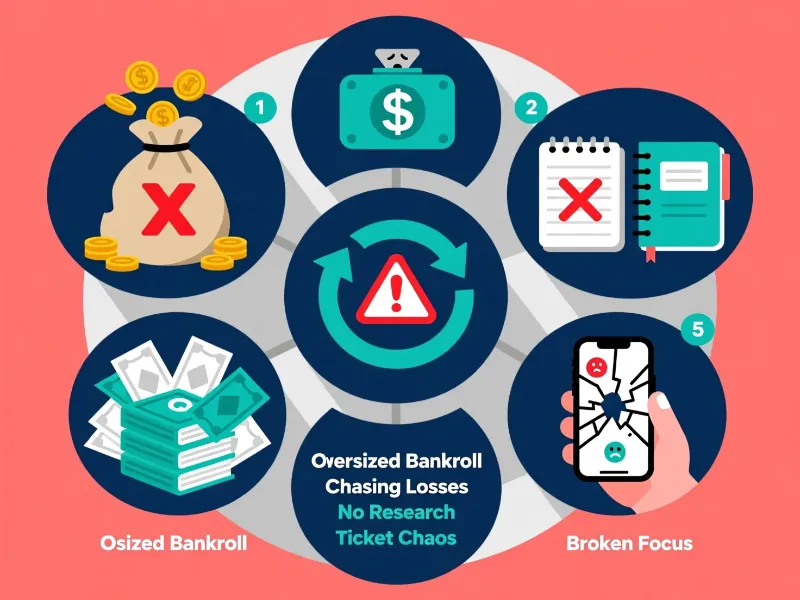
The common thread through all these mistakes is emotional decision-making overriding rational planning. The predetermined rules and limits you set before betting matter more than moment-to-moment feelings. Trust your planning self more than your emotional self.
Beginners make predictable mistakes regardless of intelligence, sports knowledge, or careful preparation. Recognizing these patterns helps you avoid them or at least recognize them quickly.
Betting too much too soon tops the list. Excitement about starting leads to larger bets than your experience justifies. The first few wins feel easy, creating false confidence. Then variance corrects, losses pile up, and your bankroll is damaged before you've learned fundamental lessons. Start smaller than feels appropriate.
Chasing losses destroys more beginners than anything else. After losing, the emotional drive to immediately win that money back is overwhelming. You bet again, probably with larger amount, probably without adequate research, probably while emotionally compromised. This compounds losses rapidly. After losing, take breaks. Wait until you're completely emotionally neutral.
Ignoring research happens when betting becomes too casual. Early bets probably involved careful analysis. As betting becomes routine, research slips. You're betting based on general impressions rather than specific current information. Injuries get missed. Form changes get overlooked. Maintain research standards even when betting feels familiar.
Betting on too many games dilutes attention and quality. If you're betting on eight games per Sunday, you're not carefully analyzing each one. You're gambling more than betting. Quality over quantity applies here more than anywhere. Fewer carefully selected bets outperform many casual bets dramatically.
Following tipsters blindly is tempting when starting out. Someone online shares picks confidently and they hit winners. You start copying their bets without understanding their reasoning. Then the inevitable losing streak happens and you're losing money while learning nothing. If you follow picks, understand the analysis behind them.
Overreacting to short-term results happens in both directions. A few wins convince you that you're naturally talented and should bet more. A few losses convince you that betting is impossible. Both reactions ignore that variance dominates short-term results. Fifty bets isn't enough to judge ability. Five hundred bets starts to show patterns.
Neglecting responsible gambling tools because they feel restrictive is dangerous. Setting limits feels like limiting upside or acknowledging you might have problems. Actually, limits are what allow sustainable betting. Without them, almost everyone eventually has periods of excess.
Betting while intoxicated or emotionally compromised seems too obvious to mention, but it happens constantly. Alcohol impairs judgment. Emotional distress impairs judgment. Betting during either produces predictably bad decisions.
The common thread through all these mistakes is emotional decision-making overriding rational planning. The predetermined rules and limits you set before betting matter more than moment-to-moment feelings. Trust your planning self more than your emotional self.
Comparing yourself to others creates unhealthy patterns. Social media and betting forums showcase big wins while hiding constant losses. Someone posts about hitting a ten-team parlay for five thousand dollars. They don't mention the hundreds of failed parlays leading to that one hit. You feel inadequate betting three dollars on moneylines while others post massive wagers. Ignore them. Their bankroll, risk tolerance, and experience level differ from yours. Comparison serves no useful purpose and encourages reckless behavior trying to match others. Focus on your own process, your own goals, your own progress. Everyone's betting journey is different, and social media highlights create distorted impressions of typical betting experiences.
Accept the latest cookie policy rules.
Sports Betting for Women Beginners: Key Lessons for Getting Started

Starting sports betting as a woman in 2025 means entering at exactly the right time. The industry finally recognizes that female bettors represent massive growth opportunity. Platforms are building better products, communities are forming, and cultural acceptance is growing. The barriers that prevented previous generations of women from betting comfortably are falling rapidly.
The advantages you bring as a woman—better emotional control, superior bankroll management, more realistic confidence levels—matter more than sports expertise or mathematical sophistication. Your natural approach to betting probably works better than what conventional wisdom prescribes. Trust your instincts about bet sizing, research thoroughness, and when to take breaks.
Starting small and learning systematically beats jumping in aggressively trying to profit immediately. Your first hundred bets are education, not income generation. Focus on understanding the process, managing your emotions, maintaining discipline, and learning from outcomes. Profitability can wait until you've built foundation.
The most important decisions are the ones you make before betting begins. What's your total bankroll? What percentage will you risk per bet? What's your monthly maximum? When will you take breaks? Answering these questions in advance and sticking to your answers regardless of emotions determines success more than any analytical edge or insider information.
Sports betting can be genuinely entertaining and engaging when done properly. It can also become stressful, expensive, and harmful when boundaries slip. The difference lies entirely in discipline, preparation, and honest self-awareness. You have everything you need to bet successfully. The question is whether you'll use it.
Starting sports betting as a woman in 2025 means entering at exactly the right time. The industry finally recognizes that female bettors represent massive growth opportunity. Platforms are building better products, communities are forming, and cultural acceptance is growing. The barriers that prevented previous generations of women from betting comfortably are falling rapidly.
The advantages you bring as a woman—better emotional control, superior bankroll management, more realistic confidence levels—matter more than sports expertise or mathematical sophistication. Your natural approach to betting probably works better than what conventional wisdom prescribes. Trust your instincts about bet sizing, research thoroughness, and when to take breaks.
Starting small and learning systematically beats jumping in aggressively trying to profit immediately. Your first hundred bets are education, not income generation. Focus on understanding the process, managing your emotions, maintaining discipline, and learning from outcomes.
The most important decisions are ones you make before betting begins. What's your total bankroll? What percentage will you risk per bet? What's your monthly maximum? When will you take breaks? Answering these questions in advance and sticking to your answers regardless of emotions determines success more than any analytical edge.
Sports betting can be genuinely entertaining and engaging when done properly. It can also become stressful, expensive, and harmful when boundaries slip. The difference lies entirely in discipline, preparation, and honest self-awareness. You have everything you need to bet successfully. The question is whether you'll use it.
Maximize your returns effortlessly through women bet.
