 WomenBet
Parlay Betting for Beginners
 Available in US

There's a reason parlay bets feature prominently in gambling movies and viral Twitter screenshots of massive wins. The premise is irresistible: combine multiple picks into a single bet, and if they all hit, your modest wager transforms into a substantial payday. A $10 bet becomes $500. A $100 bet becomes $10,000. The math gets exponentially exciting as you add more selections, and sportsbook apps make building parlays almost too easy—just keep tapping picks and watch the potential payout climb higher and higher.
But here's what the highlight reels don't show: for every viral parlay win, there are thousands of silent losses. Parlays are the single most profitable bet type for sportsbooks, not because they're complicated but because they compound risk in ways that work overwhelmingly against the bettor. Understanding exactly how parlays function—the math, the psychology, and the rare scenarios where they actually make sense—is essential before you let that "potential payout" number seduce you into bad decisions.
How Parlays Actually Work
A parlay connects multiple individual bets into one ticket. Instead of betting $50 on the Aces to cover the spread and separately betting $50 on the Storm to win outright, you combine both into a single $50 parlay. The key difference from individual bets is dependency: every single leg of your parlay must win for you to receive any payout. If the Aces cover but the Storm lose, your entire parlay is dead. You don't get partial credit.
This all-or-nothing structure is what creates both the appeal and the danger. When you bet each game individually and one loses, you still collect on the winner. Your $50 on the Aces would return around $95, partially offsetting your $50 loss on the Storm. But in a parlay, that Storm loss wipes out everything, including what would have been your Aces winnings.
The payout calculation compounds the odds of each leg together. If you parlay two bets at standard -110 odds each, the combined odds work out to roughly +264. This means a $100 parlay returns about $364 total—$264 in profit plus your original stake. Add a third leg at -110 and the odds jump to approximately +596, meaning that same $100 could return $696. Four legs pushes it to around +1228. The numbers get intoxicating quickly.
Sportsbooks calculate parlay odds by multiplying the decimal odds of each leg together. Two -110 bets convert to 1.91 in decimal format. Multiply 1.91 × 1.91 = 3.65, which converts back to +265 in American odds. The sportsbook then typically rounds slightly in their favor, which is why you might see +260 or +264 instead of the "true" mathematical result. This rounding becomes more significant as you add legs.
The Math That Works Against You
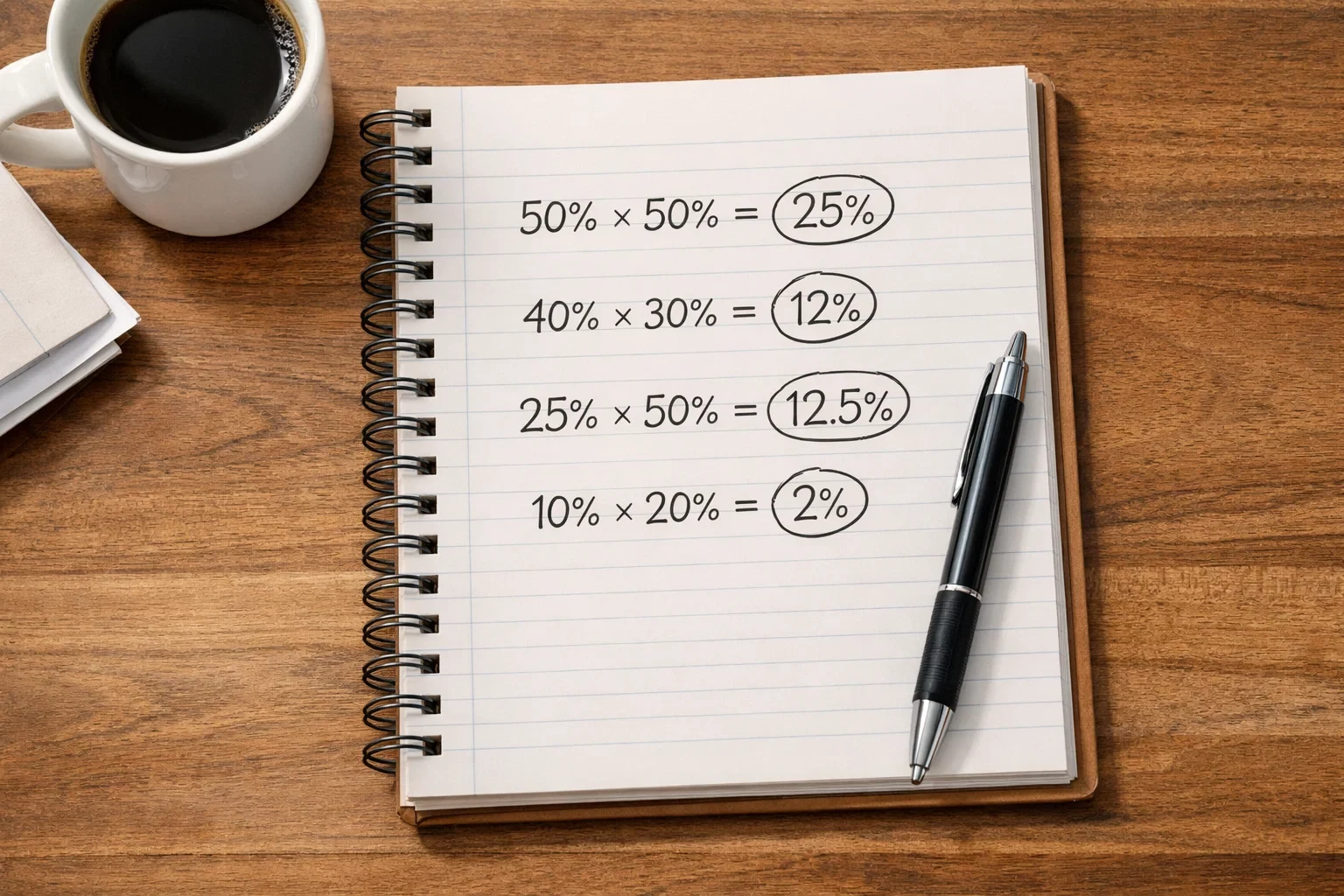
Here's where parlay betting gets mathematically ugly. At standard -110 juice, you need to win approximately 52.4% of your bets to break even on individual wagers. That's already challenging—most recreational bettors don't hit this threshold. But with parlays, the break-even requirements escalate dramatically because you're compounding that house edge on every leg.
Consider a two-team parlay with both legs at -110. The true odds of hitting both, assuming each is a 50/50 proposition, are 25% (0.5 × 0.5). Fair odds for a 25% outcome would be +300, meaning you should get $300 profit on a $100 bet. But sportsbooks typically pay around +264 for this parlay—less than true odds. That difference is the additional house edge you're accepting.
The gap widens with each added leg. A three-team parlay with 50% win probability on each leg should hit 12.5% of the time, warranting +700 odds at fair value. Sportsbooks generally pay around +596 for this, keeping the difference. A four-team parlay at true 50/50 odds (6.25% to hit all four) should pay +1500, but you'll typically get around +1228. By the time you reach an eight-team parlay, the house edge can exceed 30%.
What this means practically is that even skilled bettors who can identify value in individual games often destroy that value by putting their picks into parlays. If you've found three games where you genuinely have edge—say, 54% probability instead of 50%—you're better off betting them separately than combining them. The parlay structure erases your carefully cultivated advantage.
Why Sportsbooks Love Parlays (And You Should Be Suspicious)
Walk into any sportsbook or browse any betting app, and you'll notice parlays receive prominent placement. Same-game parlay builders appear at the top of game listings. Promotional offers frequently incentivize parlay betting specifically. This isn't because sportsbooks want you to win big—it's because parlays generate outsized profits for the house.
Industry data reveals that parlays account for a disproportionate share of sportsbook revenue relative to betting volume. One estimate suggested parlays represent about 30% of wagers but over 60% of profits for some operators. That ratio tells you everything you need to know about expected value. The very bets sportsbooks push hardest are the ones most favorable to the house.
The psychology works in sportsbooks' favor too. A near-miss on a parlay—hitting four of five legs—feels like almost winning, encouraging another attempt. But mathematically, four-of-five is exactly the same result as zero-of-five: you lose your entire stake. The emotional experience doesn't match the financial reality, and that mismatch keeps bettors coming back to try again.
Same-game parlays (SGPs) deserve special skepticism. These allow you to combine multiple bets from a single game—say, the Fever spread, the over/under, and Caitlin Clark's points total. SGPs are popular because outcomes feel correlated (if Clark scores a lot, the Fever probably do well), but sportsbooks price this correlation aggressively. The odds on SGPs are often significantly worse than traditional cross-game parlays, with books adding 10-20% extra edge to account for interdependencies.
Explore strictly the womens tennis markets.
When Parlays Might Actually Make Sense
Despite everything above, there are limited scenarios where parlay betting isn't purely irrational. Understanding these exceptions helps distinguish strategic parlay use from gambling for thrills.
First, parlays make sense for combining heavy favorites with poor standalone value. If you want to bet three different teams that are each -300 on the moneyline, betting them individually requires risking $300 to win $100 on each. That's $900 at risk for $300 in potential profit, and one loss wipes out gains from the other two. Combining these into a parlay might offer odds around +170, meaning $100 can win $170 if all three favorites win. You've converted three expensive bets into one cheaper ticket with similar upside, though you've also created an all-or-nothing outcome.
Second, small-stake entertainment parlays have a place for casual bettors who understand they're paying for excitement rather than expected value. If you allocate $20 weekly for parlay entertainment, knowing you'll likely lose but occasionally hit something fun, that's a legitimate form of entertainment spending—no different than buying movie tickets or lottery scratchers. The key is honest accounting: this is entertainment cost, not investment strategy.
Third, correlated parlays that the sportsbook has mispriced can offer value. If you identify a situation where one outcome makes another significantly more likely, and the sportsbook hasn't fully adjusted the SGP odds to reflect that correlation, you might have an edge. This is rare and requires genuine expertise, but it exists. For example, if inclement weather makes you confident a football game will be low-scoring, betting the under plus the underdog (who's more likely to win a rock fight than a shootout) might offer correlated value.
Building Smarter Parlays

If you're going to bet parlays despite the mathematical headwinds, at least approach them strategically. A few principles can limit damage and occasionally optimize returns.
Keep leg counts low. Two or three-leg parlays maintain a somewhat reasonable relationship between risk and reward. Once you exceed four or five legs, you're essentially buying lottery tickets. The odds of hitting a ten-leg parlay are astronomical regardless of your handicapping skill.
Avoid parlaying correlated favorites you'd never bet individually. Many bettors build parlays of teams they're "sure" will win, but wouldn't bet the -250 or -400 moneylines on their own. This is backwards—if the individual lines don't offer value, combining them doesn't create value. You're just adding more losing bets to your losing bet.
Line shop for each leg before finalizing the parlay. Different sportsbooks offer different odds on the same events, and these differences compound in parlays. If one book has a team at -105 instead of -110, that slightly better price improves your overall parlay odds. Use this to your advantage.
Consider round-robin parlays to reduce variance if you have strong conviction on multiple picks. A round-robin takes your selections and creates every possible smaller parlay combination. If you have four picks, a round-robin might create all six two-team parlays, all four three-team parlays, and one four-team parlay—eleven bets total. This means you can still profit even if one leg loses, though you're betting more total money.
Don't use parlay insurance promotions as justification for otherwise bad bets. Some sportsbooks offer "insurance" where you get a bonus bet back if one leg of a long parlay misses. This sounds generous but usually comes with restrictions that reduce its actual value. The insurance doesn't transform a -EV bet into a +EV bet.
Parlay Betting for Beginners: When Multi-Leg Bets Make Sense
Here's the bottom line on parlay betting: it's a high-variance, low-expected-value proposition that the house loves and mathematically informed bettors typically avoid. The big wins you see shared online represent survivorship bias—the countless losses aren't documented.
If you're betting to grow your bankroll long-term, parlays are almost certainly hurting you. The compounded house edge means you're consistently paying more for the same underlying outcomes than you would with straight bets. Professional bettors rarely use parlays outside of very specific arbitrage or correlated situations.
If you're betting for entertainment and understand the cost, parlays can provide outsized excitement relative to stake size. Just be honest about what you're paying for. That potential $500 payout on a $10 ten-leg parlay isn't a realistic expected outcome—it's a lottery ticket with slightly better odds than Powerball but still firmly negative expected value.
The seduction of parlays is real. Watching a big parlay come down to the final leg is genuinely thrilling, and hitting one creates stories worth telling. But sustainable betting success isn't built on occasional parlay lightning strikes. It's built on consistent, disciplined individual bets where you've identified genuine value and managed risk appropriately.
Use parlays sparingly if at all, never bet more than you'd spend on other entertainment, and absolutely do not chase parlay losses with bigger parlays hoping to recover. That path leads nowhere good. The sportsbooks didn't build billion-dollar companies by accident—they built them partly on the mathematical certainty that parlay bettors will, in aggregate, lose more than they should.
Know what you're signing up for before you hit submit on that ten-leg ticket. Sometimes the most valuable bet is the one you don't make.
Bet securely every single time at women bet.
