 WomenBet
Understanding Sportsbook Bonuses
 Available in US

Sportsbook promotions look irresistible. "Get $300 in bonus bets!" "100% deposit match up to $1,000!" These offers flash across your screen, promising free money that seems too good to pass up. But like most things in gambling, the details matter more than the headlines.
Understanding how sportsbook bonuses actually work—including the fine print that operators don't emphasize—helps you evaluate which offers provide genuine value and which are better declined. This article breaks down the common bonus types, explains the critical terms you need to watch for, and helps you make informed decisions about promotions.
How Sportsbooks Think About Bonuses
Before examining specific offers, it's worth understanding why sportsbooks offer bonuses at all.
Customer acquisition is expensive. In a competitive market with dozens of legal sportsbooks fighting for users, operators invest heavily to attract new bettors. Bonuses serve as inducements—essentially marketing costs designed to get you through the door and betting on their platform.
Sportsbooks aren't giving away free money, though. Every bonus comes with conditions designed to ensure you actually engage with the platform before you can withdraw any value. The goal is attracting customers who will continue betting after the promotion ends, not people who grab bonuses and disappear.
This means bonuses can provide real value to bettors who planned to bet anyway, but rarely deliver the full advertised amount as withdrawable cash. The terms and conditions determine whether a bonus helps you or primarily benefits the sportsbook.
Common Bonus Types
Legal U.S. sportsbooks offer several standard promotion structures. Understanding each type helps you evaluate what you're actually getting.
First Bet Insurance (also called "No Sweat Bet" or "Bet and Get") is currently the most common welcome offer. You place your first bet, and if it loses, the sportsbook refunds your stake as bonus bets. FanDuel and BetMGM frequently offer this structure, with insurance amounts ranging from $200 to $1,500 depending on the promotion and state.
The catch: you receive bonus bets, not cash. If your first bet wins, you get nothing extra—just your normal winnings. And the bonus bets you receive if you lose have their own restrictions.
Bet and Get offers require you to place a qualifying bet to receive bonus bets. For example, "Bet $5, Get $200 in Bonus Bets" means wagering at least $5 triggers the bonus regardless of whether that bet wins or loses. Some versions require the qualifying bet to win; read carefully.
Deposit Match bonuses multiply your initial deposit by some percentage. A "100% match up to $500" doubles whatever you deposit, up to a $500 maximum. These were more common in earlier years of legal U.S. betting and remain popular at offshore books, though many regulated sportsbooks have moved away from them.
The catch: deposit matches almost always come with rollover requirements (explained below), meaning you can't immediately withdraw the bonus funds.
Bonus Bets (previously called "free bets") let you place wagers using sportsbook credits rather than your own money. If the bonus bet wins, you keep the profit but not the original stake. A $50 bonus bet at +150 odds that wins pays $75, not $125—the $50 stake disappears.
Odds Boosts enhance the payout on specific bets, usually tied to particular games or markets. If the normal odds on a bet are +100, an odds boost might offer +150 instead. These are typically available to all users, not just new customers.
Reload Bonuses target existing customers with deposit matches or bonus bets for additional deposits after the initial welcome offer. These are smaller than welcome bonuses but can add ongoing value.
Critical Terms to Understand
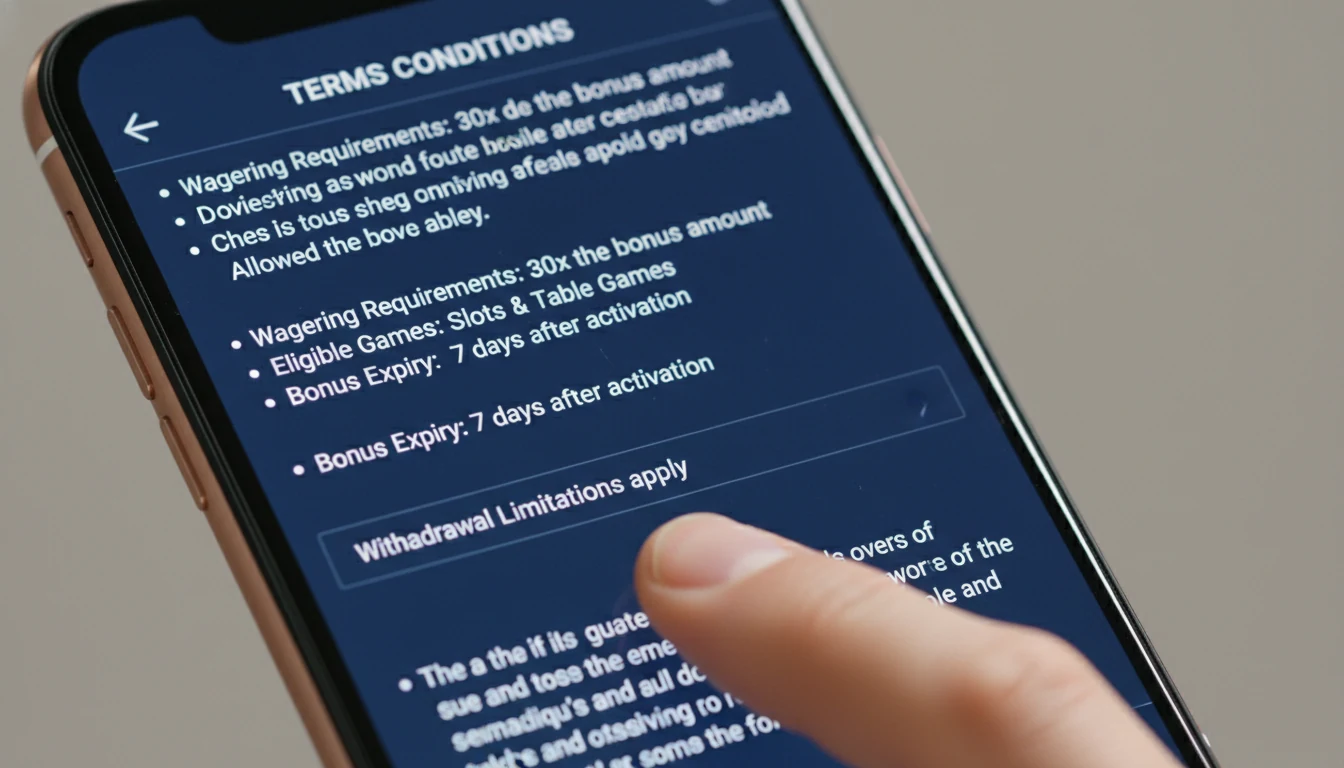
The headline number on a bonus tells you almost nothing about its actual value. These terms determine whether a promotion is worth claiming.
Rollover Requirements (also called playthrough or wagering requirements) specify how much you must bet before withdrawing bonus funds. A "5x rollover" on a $100 bonus means wagering $500 total before that $100 becomes withdrawable.
Rollover requirements vary dramatically. The best sportsbooks offer 1x rollover (bet the bonus amount once) or no rollover on certain promotions. Others require 10x, 15x, or higher multipliers. Generally, lower rollover equals better value.
Watch whether rollover applies to just the bonus or to your deposit plus the bonus. A 5x rollover on a $100 deposit match seems manageable until you realize it applies to the full $200 ($100 deposit + $100 bonus), requiring $1,000 in total wagers.
Odds Restrictions prevent you from meeting rollover by betting on heavy favorites. Most promotions require bets at -200 or higher (meaning underdogs or slight favorites only). Some set the threshold at -300 or -150. Bets on larger favorites don't count toward your rollover.
Time Limits give you a window to use bonus bets or complete rollover requirements—typically 7 to 30 days. Unused bonus bets expire and disappear from your account. Uncompleted rollover may result in forfeiting any bonus-related winnings.
Eligible Markets sometimes restrict where you can use bonuses. Some promotions exclude certain sports, bet types, or markets. A bonus that seems valuable becomes less so if you can only use it on sports you don't follow.
Bonus Bet Rules specify what happens when a bonus bet wins. Standard terms return only the profit, not the stake. So a winning $100 bonus bet at +100 pays $100, not $200. Some bonus bets must be used all at once; others can be split into smaller wagers.
Maximum Withdrawal Limits cap how much you can withdraw from bonus-derived winnings, though these are less common at regulated U.S. sportsbooks than at offshore operators.
Evaluating Welcome Offers
Here's how to assess whether a welcome offer provides genuine value.
Compare the actual expected value, not the headline number. A "$1,000 First Bet Insurance" sounds huge, but you only receive that value if your first bet loses. If you bet $1,000 and win, you get nothing extra. If you bet $100 and lose, you get $100 in bonus bets—not $1,000.
Consider what you'd bet anyway. Bonuses provide the most value to bettors who planned to wager that amount regardless. If you'd normally bet $20 per game, a promotion requiring a $500 first bet pushes you outside your comfort zone just to chase a bonus.
Assess the rollover realistically. A 10x rollover on a $500 bonus sounds fine until you calculate that you need to place $5,000 in bets. If you normally bet $50 per game, that's 100 bets—probably more than you'd place in the typical 30-day window.
Factor in the house edge. While working through rollover, you're making bets where the house has roughly a 4.5% edge (on standard -110 lines). A $500 bonus with 10x rollover means betting $5,000, losing roughly $225 to the house edge. Your net expected value is $275 ($500 - $225), not $500.
Check for simpler alternatives. BetRivers offers 1x rollover on their deposit match—dramatically better than competitors with 5x or 10x requirements. Sometimes a smaller bonus with better terms beats a bigger bonus with onerous conditions.
Welcome Offer Examples Analyzed
Let's examine several common offers to show how evaluation works in practice.
FanDuel: "Bet $5, Get $250 in Bonus Bets If Your Bet Wins"
Simple terms: deposit $5 minimum, bet $5 on anything, and if you win, receive $250 in bonus bets. No rollover on the bonus bets themselves—you can use them immediately.
Catch: Your qualifying bet must win to trigger the bonus. If it loses, you get nothing.
Verdict: Low-risk offer since you're only committing $5. Good for cautious new bettors.
BetMGM: "First Bet Insurance Up to $1,500"
If your first bet loses, receive matching bonus bets. Bet $1,500 and lose, get $1,500 in bonus bets.
Catch: You need to risk $1,500 of your own money to maximize the offer. Bonus bets expire in 7 days and return only profit, not stake.
Verdict: High-value if you're comfortable with large initial bets. Not optimal for small-bankroll recreational bettors.
BetRivers: "100% Deposit Match Up to $250, 1x Rollover"
Double your deposit up to $250, with only 1x playthrough required.
Catch: Maximum bonus is $250, lower than some competitors.
Verdict: The 1x rollover makes this exceptionally valuable. Better expected value than larger bonuses with higher rollover.
DraftKings: "Bet $5, Get $200 If Your Bet Wins"
Similar structure to FanDuel—small qualifying bet triggers bonus bets if it wins.
Catch: Qualifying bet must win. Bonus bets expire in 7 days.
Verdict: Another low-risk option for cautious bettors.

Mistakes to Avoid
Common errors reduce or eliminate the value of sportsbook bonuses.
Not reading the terms. Many bettors claim bonuses without understanding the conditions, then discover they can't withdraw winnings or their bonus bets expired. Always read the fine print before opting in.
Betting differently to chase bonuses. If a promotion pushes you to bet larger amounts, on unfamiliar sports, or more frequently than you normally would, you're likely losing more to bad decisions than you're gaining from the bonus.
Forgetting time limits. Bonus bets expire, often within 7 days. If you claim a promotion and then don't bet for a week, you've wasted the offer entirely.
Ignoring odds restrictions. Bets on heavy favorites often don't count toward rollover. If you're trying to complete a 5x requirement and half your bets are on -300 favorites, you're not making progress.
Expecting withdrawable cash. Bonus bets aren't money. They're wagering credits that only become money if you win bets with them. The headline "$500 in bonus bets" might translate to $200-$300 in expected withdrawable value.
Claiming bonuses you don't need. Some bonuses lock your funds until rollover is complete. If you might want to withdraw before finishing the requirements, declining the bonus keeps your money accessible.
Ongoing Promotions
Welcome offers get the most attention, but ongoing promotions provide value to regular bettors.
Daily odds boosts enhance payouts on specific bets. While individual boosts are small, consistently taking advantage of positive-expectation boosts adds up over time.
Parlay insurance refunds your stake as bonus bets if one leg of a parlay loses. This effectively reduces parlay variance while maintaining upside.
Profit boosts add percentage increases to winnings on qualifying bets. A 25% profit boost on a $100 bet at +100 turns your $100 profit into $125.
Refer-a-friend bonuses reward you for bringing new bettors to the platform, typically $25-$100 per successful referral.
Loyalty programs award points for betting activity, redeemable for bonus bets or (at some operators) real-world rewards like hotel stays or merchandise.
Sportsbook Bonuses Explained: Key Terms, Risks, and Value Factors
Sportsbook bonuses can provide genuine value, but rarely as much as the advertising suggests. The bettors who benefit most are those who:
Read and understand the complete terms before claiming
Would bet those amounts anyway, bonus or not
Choose promotions with low or no rollover requirements
Use bonus bets promptly before expiration
Don't change their betting behavior to chase promotional value
If a bonus seems too good to be true, examine the fine print. The value is usually hidden in the details—rollover requirements, odds restrictions, time limits, and bonus bet rules that reduce the advertised headline to a more modest reality.
Treat bonuses as a small boost to betting you'd already planned, not as free money or a reason to bet more than you should. With realistic expectations and careful attention to terms, promotions can enhance your betting experience without creating problems.
