 WomenBet
How to Read Sports Betting Odds
 Available in US

The first time you open a sportsbook app, you're greeted with a wall of numbers that might as well be hieroglyphics. Minus signs, plus signs, three-digit figures arranged in columns—it looks like the control panel of a spaceship designed by accountants. Here's the thing though: once you crack the code, these numbers become remarkably simple. In fact, women who take the time to understand odds properly tend to make better betting decisions than men who've been gambling for years but never bothered to learn the fundamentals. That's not speculation—research consistently shows female bettors achieve significantly higher ROI, partly because they actually do their homework before risking money.
Understanding betting odds isn't just about knowing what the numbers mean. It's about understanding what they're telling you—the implied probability of an outcome, the potential return on your investment, and whether a bet actually offers value. This guide breaks down the three major odds formats you'll encounter, with a focus on American odds since that's what you'll see most often on US sportsbooks. By the end, you'll be reading lines like a professional handicapper, or at least like someone who knows what she's doing.
The Logic Behind the Numbers
Before diving into specific formats, it helps to understand what odds actually represent. At their core, betting odds serve two purposes: they indicate the probability of something happening, and they tell you how much you'll win if your bet is correct. Sportsbooks employ teams of analysts and use sophisticated algorithms to set these numbers, but the underlying concept is straightforward. The less likely an outcome, the more the sportsbook will pay you for correctly predicting it. The more likely an outcome, the less you'll win.
The catch is that odds don't represent true probability. Sportsbooks build in a margin—commonly called the "vig" or "juice"—that ensures they make money regardless of the outcome. If both sides of a bet had true 50/50 odds, each would be listed at +100 in American format. Instead, you'll typically see both sides at -110, meaning you must risk $110 to win $100. That extra $10 on each side is how the house makes its profit. Understanding this margin is crucial because it means you're not just trying to predict winners—you're trying to find situations where your analysis suggests the true probability is better than what the odds imply.
This concept of "value" is where serious bettors separate themselves from recreational gamblers. A team might be heavily favored to win, but if the odds don't accurately reflect how favored they should be, betting on them could still be a mistake. Conversely, a massive underdog can be a smart bet if the sportsbook has underestimated their chances. The numbers themselves are neutral—they're just information waiting to be interpreted.
American Odds: The Plus and Minus System
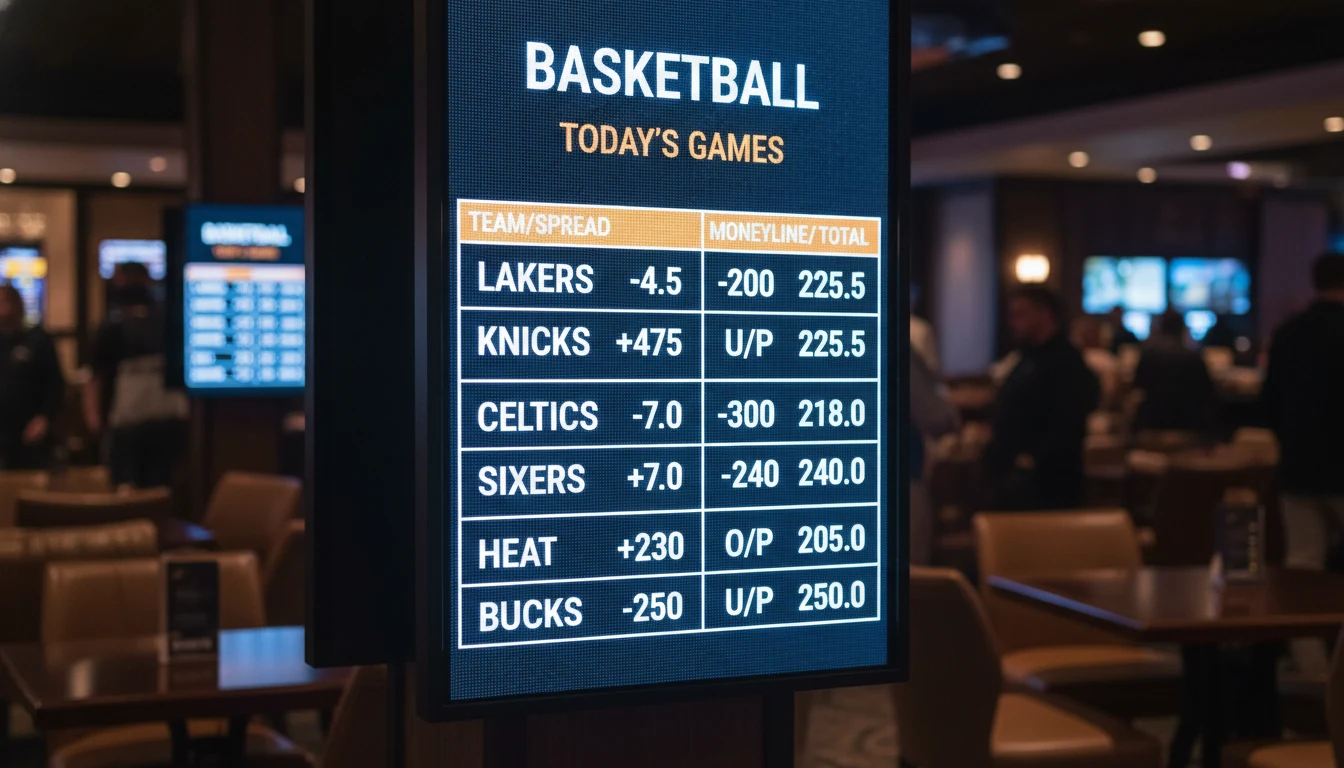
American odds dominate the US sports betting landscape, and they're what you'll encounter on every major sportsbook app like FanDuel, DraftKings, and BetMGM. The format uses positive and negative numbers built around a $100 baseline. Once you internalize this system, reading any betting line becomes automatic.
Negative numbers indicate favorites—the team or outcome expected to win. The number tells you how much you need to bet to win $100 in profit. For example, if the Las Vegas Aces are listed at -150 against the Phoenix Mercury, you'd need to wager $150 to win $100. If the Aces win, you get back your $150 stake plus $100 in profit, for a total return of $250. The larger the negative number, the heavier the favorite. Odds of -300 mean betting $300 to win $100, indicating the sportsbook considers that outcome highly probable.
Positive numbers indicate underdogs—the team or outcome expected to lose. Here, the number tells you how much you'd win on a $100 bet. If the Mercury are listed at +130 in that same game, a $100 wager returns $130 in profit if Phoenix pulls off the upset, plus your original $100 stake for $230 total. The larger the positive number, the bigger the underdog and the juicier the potential payout. A team at +500 would return $500 profit on a $100 bet, but the sportsbook clearly doesn't think they have much chance of winning.
The beauty of American odds is their scalability. You don't need to bet in $100 increments. The ratios work the same regardless of stake size. At -150 odds, a $30 bet wins $20 in profit. At +130, a $50 bet wins $65. Modern sportsbook apps calculate this automatically when you enter your desired stake, but understanding the underlying math helps you quickly assess whether a line offers value without pulling out a calculator.
Converting American Odds to Probability
Here's where things get genuinely useful. Every set of odds implies a probability—what the sportsbook believes is the likelihood of that outcome occurring. Converting American odds to implied probability helps you compare the sportsbook's assessment against your own analysis.
For negative odds, the formula is: Odds / (Odds + 100) x 100. At -150, this works out to 150 / (150 + 100) x 100 = 60%. The sportsbook is saying the favorite has roughly a 60% chance of winning. For positive odds, the formula is: 100 / (Odds + 100) x 100. At +130, this becomes 100 / (130 + 100) x 100 = 43.5%. The underdog has an implied 43.5% chance.
You'll notice these probabilities add up to more than 100% (60% + 43.5% = 103.5%). That's the vig in action. In a perfectly efficient market with no house edge, the probabilities would sum to exactly 100%. The overround—that 3.5% excess—represents the sportsbook's built-in profit margin. Different books have different overrounds, and sharper bettors seek out sportsbooks with lower margins to maximize their returns over time.
Understanding implied probability transforms how you evaluate bets. Instead of thinking "I like the Aces to win this game," you can think "I believe the Aces have a 70% chance of winning, but the odds only imply 60%. That's a value bet." This shift from gut-feeling gambling to probability-based analysis is what separates profitable bettors from the majority who lose money over the long run.
Decimal Odds: The European Standard
While American odds dominate US sportsbooks, you'll occasionally encounter decimal odds, especially on international betting sites or when betting on soccer. Decimal odds are actually simpler mathematically, which is why many professional bettors prefer them.
Decimal odds represent your total return per unit staked, including your original bet. If the odds are 2.50, a $100 bet returns $250 total—$150 profit plus your $100 stake. If the odds are 1.80, a $100 bet returns $180 total—$80 profit plus your $100 stake. Any decimal below 2.00 represents a favorite (you're getting back less than double your stake), while decimals above 2.00 represent underdogs.
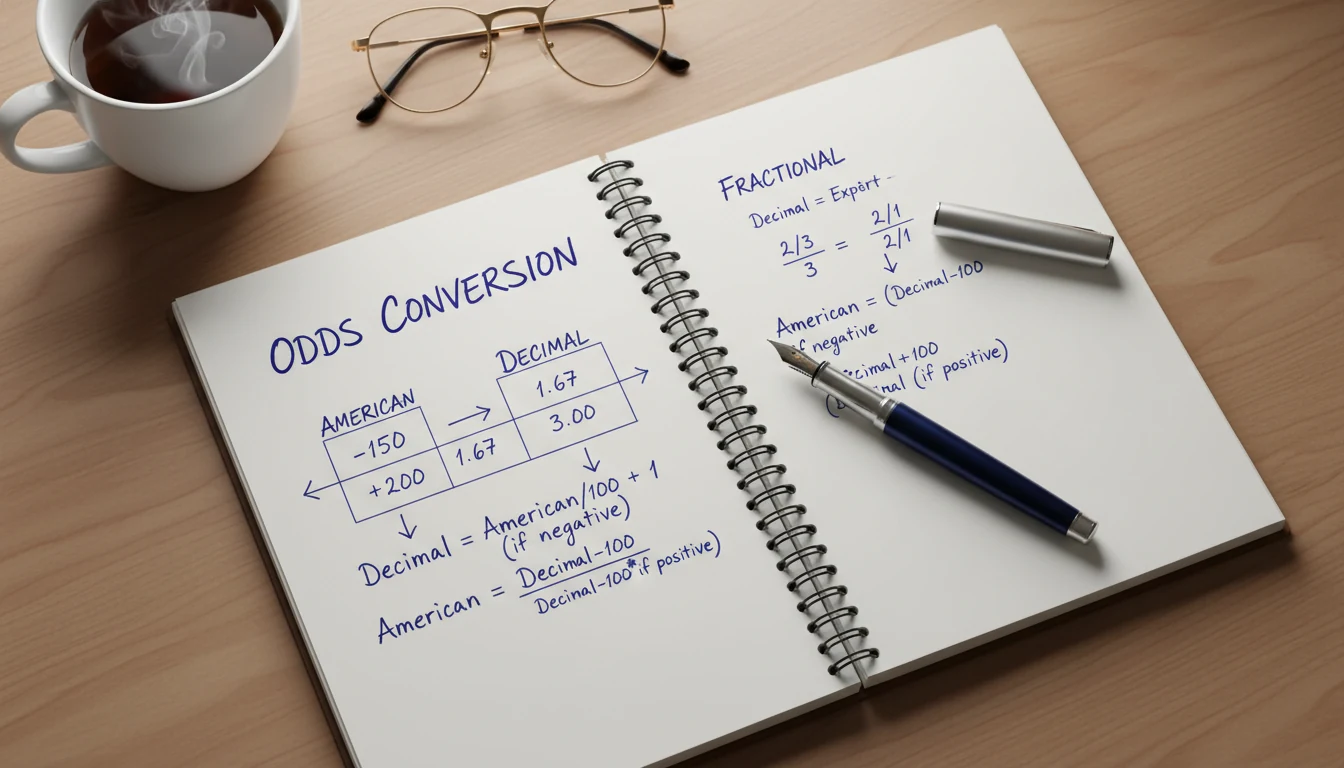
Converting between formats is straightforward once you know the formulas. To convert positive American odds to decimal: (American odds / 100) + 1. So +150 becomes (150/100) + 1 = 2.50. To convert negative American odds: (100 / American odds) + 1. So -150 becomes (100/150) + 1 = 1.67. Going the other direction, decimals above 2.00 become positive American odds: (Decimal - 1) x 100. Decimals below 2.00 become negative American odds: -100 / (Decimal - 1).
The advantage of decimal odds is that calculating potential returns requires just one multiplication. The disadvantage for American bettors is simply unfamiliarity—we've trained our brains to process plus and minus signs, not decimal points. Most US sportsbooks let you toggle between formats in your account settings, so experiment to see which feels more intuitive for your decision-making process.
Fractional Odds: The Traditional Format
Fractional odds are the oldest format, still popular in UK horse racing and occasionally appearing on American sportsbooks for certain markets. They express your potential profit relative to your stake as a ratio.
Odds of 3/1 (read as "three to one") mean you win $3 for every $1 wagered. A $100 bet returns $300 profit plus your $100 stake. Odds of 1/4 ("one to four" or "four to one on") mean you win $1 for every $4 wagered—a heavy favorite where a $100 bet returns only $25 profit plus your $100 stake. The first number represents potential profit, the second represents the stake required to earn that profit.
Fractional odds can get awkward with numbers like 11/8 or 6/4, which is partly why decimals have gained popularity. Converting fractional to decimal is simple: divide the first number by the second and add 1. So 3/1 becomes (3/1) + 1 = 4.00 decimal. Converting to American odds: if the fraction is greater than 1/1 (even money), multiply by 100 for positive American odds. 3/1 becomes +300. If the fraction is less than 1/1, divide -100 by the decimal value. 1/4 equals 0.25, so -100/0.25 = -400.
For American bettors, fractional odds are mostly a curiosity unless you're betting on horse racing or using UK-based sportsbooks. Still, understanding all three formats means you can shop for the best lines across any platform without getting confused by different presentations of the same information.
Putting It All Together
Reading odds fluently isn't about memorizing formulas—it's about developing intuition for what the numbers mean. After a few weeks of active betting, you'll glance at -180 and automatically think "heavy favorite, about 64% implied probability, need to be pretty confident to bet this." You'll see +250 and know it's a significant underdog at around 29% implied odds, potentially lucrative if you have strong reasons to believe the sportsbook is undervaluing that side.
The practical skill is comparing odds across sportsbooks. Line shopping—checking multiple platforms for the best available odds—can add percentage points to your long-term returns. The same bet might be -115 on one app and -105 on another. That difference looks small but compounds significantly over hundreds of bets. Women tend to excel at this kind of methodical comparison shopping, which partially explains the documented advantage female bettors have in ROI.
Start with American odds since that's what you'll encounter most frequently. Get comfortable converting to implied probability so you can assess value rather than just picking winners. As you gain experience, you'll develop your own sense of when the numbers feel "off" and when they seem about right. That instinct, combined with solid research and disciplined bankroll management, is the foundation of profitable sports betting. The odds themselves are just the language—learning to speak it is the first step toward having meaningful conversations with your money.
